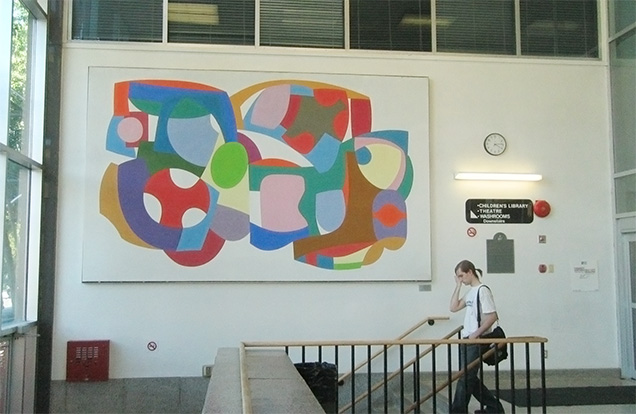
Doug Morton had just come down from his studio to show me a touch of pigment on a finger tip. To me it was a repulsive greyed-off yellow ochre. To the question, however, my response was probably non-committal.
We occupied studio space in a handsome 1860 red-brick farmhouse known as Stong House after its first pioneer owner. It is on an isolated corner of York university campus in North York, Ontario, where Doug and I both taught. On the second floor he had had the wall between two bedrooms removed to create a large well-lit studio. There, at a distance, he would sit in a hideous brown vinyl armchair to contemplate a slowly evolving canvas which was stapled to an eight foot square plywood easel. In one corner was a disgustingly discoloured sink, to one side a table with numerous jars of acrylic paint and near his chair on the floor, various and generally old art magazines in considerable disarray.
↑ ↓ ↑ ↓
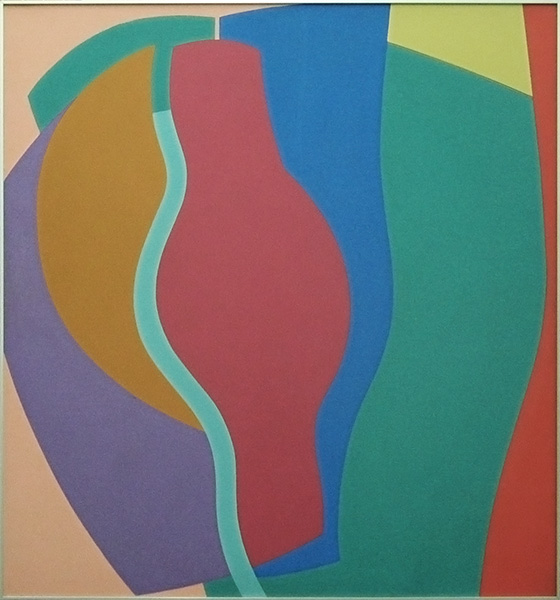
Red Mandala, 1967, MackenZie Art Gallery, acrylic on canvas, 143x135cm
Later that same day when it was time to decide whether to have a touch of scotch or rye I went upstairs where that utterly vulgar colour had been transformed in his painting into a glorious radiant golden hue. What I had seen in isolation, he had envisioned in the complex context of adjoining colours and carefully controlled forms of unique hues. For me it was always a liberating experience after working on white panels all afternoon under harsh fluorescent lights to be refreshed by the dynamic Morton colours.
↑ ↓ ↑ ↓
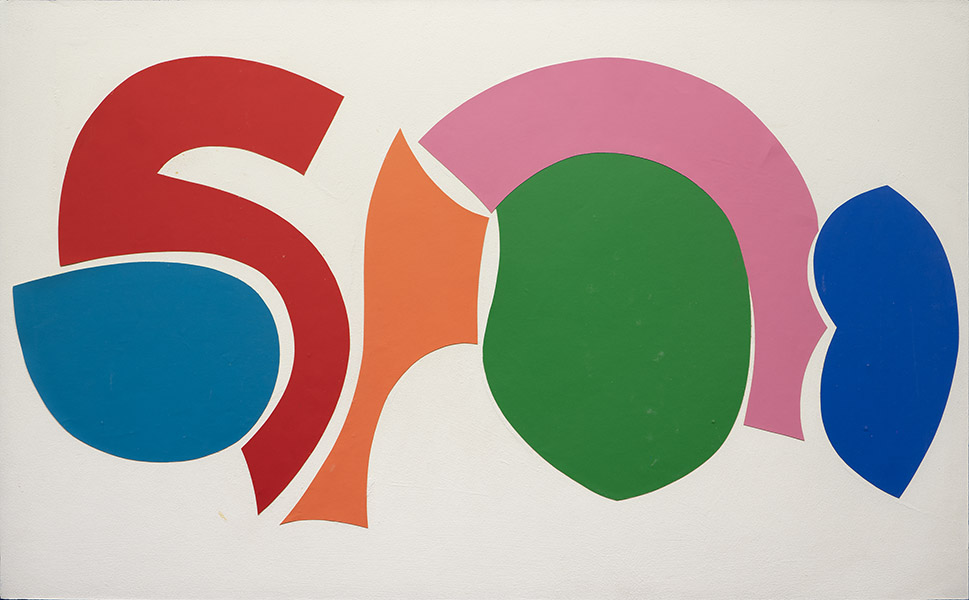
Collage in the Estate Collection
Morton's bold imagery is difficult to place within a Canadian visual art milieu because his roots seem to be in the apparently contradictory sources of pre-war French Purism and German Expressionism. In the post-war era he studied in both Paris and London with André L'Hote and Martin Bloch respectively and not within the conventional North American art school or university experience. Morton's vision is non-representational. It is also monumental and powerful; these are not characteristics normally associated with art of his generation in Canada.
↑ ↓ ↑ ↓
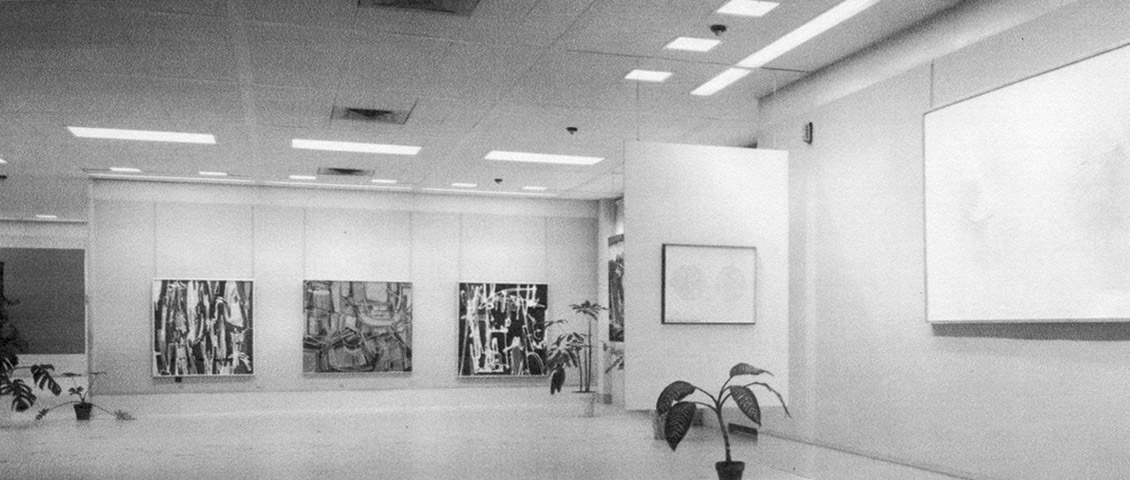
Three Mortons in the National Gallery of Canada, 1961
The 2nd is Auction, the 3rd is Green Night, both NGC Collection
I first saw his early works in the late fifties in Regina, Saskatchewan; works of various sizes, shapes and media. These already reflected a serious search for a coherent visual language through technical experimentation with varied themes. One, a gouache of the white cliffs at Gravesend, England, has a highly stylized cloud in one corner which prefigures his fully developed style of boldly interlocking forms. The treatment of that shape - a necessary formal element - is almost abstract in a way that the major thematic elements are not. Stated another way his future direction is to be found in a virtually incidental passage of an early work. His individual, recognizable manner of image-making gradually appeared while retaining something of Purism's simplified shapes and the potency of Expressionism's colours. From those and inner resources he has created a series of impressive canvases whose closest analogy in a Canadian relationship are the great totem poles of the West Coast where he now resides. His featureless, iconic images are intense centres of aesthetic resolution just able to hold vital emotions within necessary constraints.
↑ ↓ ↑ ↓
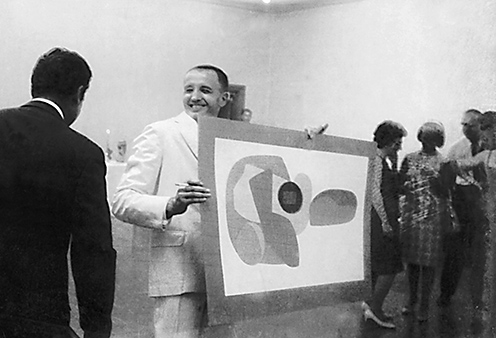
Doug making Bloore crack up as he presents one of his prints.
Morton has the most formidable formal eye that I have ever encountered. His analysis is invariably quick and accurate. Major problems in terms of spatial factors, tone or the like are precisely put in order whereas within his own work the organic building of each painting involves reliance on chance and deliberate choices. He constantly changes areas by modifying forms or altering hues as he reassesses prior decisions. On a large format he has a multitude of choices. One painting, titled Bee, caused him a moment's anguish; it had been accepted and photographed for an exhibition. Nevertheless, before it was sent off it underwent a conspicuous alteration. The obvious change, I suspect, was never noticed.
↑ ↓ ↑ ↓
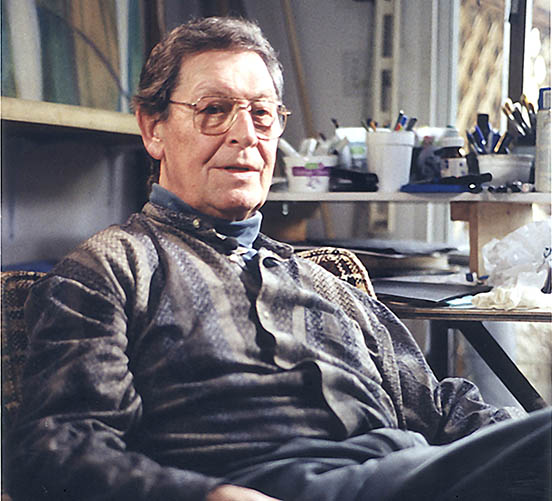
In his painting studio in Victoria, BC
Most artists in this country have to work and Doug is no exception. He has worked successfully as a businessman, a professor and a university administrator. He is also an extraordinarily dedicated family man. Such time consuming factors may have limited his studio activities but certainly not their clearly evident qualities. The consistency of form and content reflect a sustained conviction of painterly purpose while his intuitively determined direction is given order by formal decisions which transcend the temporary.
↑ ↓ ↑ ↓